
Hibiscus tea is a herbal drink that can be enjoyed both hot and cold, and that also lends itself beautifully to many variations.
What makes this tea special is that it has a relaxing effect when enjoyed warm, while the cold version is refreshing and gently activating.
The drink has a fresh, slightly sour taste and a deep red color.
I first encountered the cold version in the Middle East, where it is known as karkadee. Interestingly, only later did I realize that it was actually hibiscus. In the Netherlands I had tasted hibiscus tea before, but I didn’t like it very much at the time – probably because it was made from tea bags instead of whole dried leaves.
Since I started making my own syrups and especially drink this tea during the summer and serve it to clients after treatments, I became more curious about where this plant comes from, what its benefits are, and how many ways there are to prepare both warm and cold drinks from it.
The hibiscus plant and its leaves
There are well over 200 species of hibiscus in the world, ranging from annuals to small trees. And virtually all of the flowers are edible. The flowers come in many colors: white, red, pink, yellow, orange, purple, and blue.
In the Netherlands, the garden hibiscus (Hibiscus syriacus) is particularly well-known; it is hardy and blooms in the autumn. And in the southh of Europe the hibiscus rosa-sinensis.
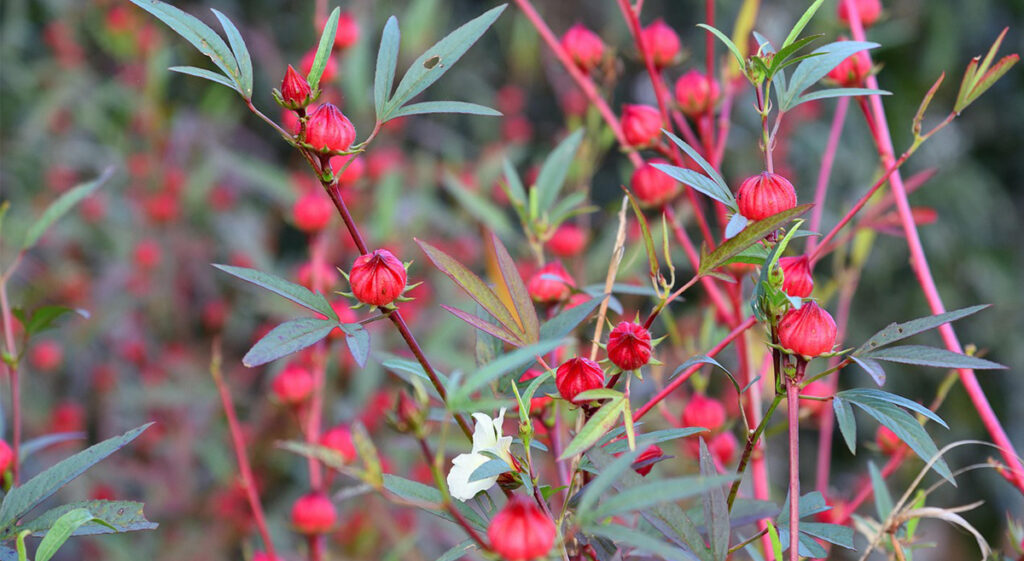
Hibiscus tea is usually made from Hibiscus sabdariffa, also known as Roselle.
This is a tropical plant that grows mainly in warm regions such as Africa, Asia, the Caribbean, and Central America.
What is special is that the sepals, in particular, are used for tea. They are located at the base, behind the flower. However, they are often simply called “hibiscus leaves”.
After flowering, these calyxes are harvested and dried. Once dried, they have a deep red to purple color and an intensely fresh, slightly sour taste. You could compare it a bit to cranberry or pomegranate.
On an energetic level, the hibiscus plant symbolizes feminine energy, openness, and vitality.
Hibiscus tea: a herbal tea with character
Hibiscus tea is a herbal tea and naturally caffeine-free. It is easily recognized by its bright red color and its fresh, lightly sour taste.
Mogelijk wordt deze drank al eeuwen gedronken in verschillende culturen en is bekend onder This drink has likely been consumed for centuries in different cultures and is known under various names, such as Roselle, Karkadé or Karkadee in the Middle East and North Africa. In the Caribbean it is called Sorrel, where it is sometimes even mixed with beer. In Central America it is known as Saril or Flor de Jamaica / Agua de Jamaica.
Although the preparation differs from place to place, the deep red color and refreshing quality remain characteristic.
Energetically, hibiscus is often associated with the heart chakra, emotional flow, releasing what is stuck and refreshment on both a physical and energetic level
How to make warm hibiscus tea
When enjoyed warm, hibiscus tea is perfect for relaxation.
For 1 cup:
Add 1–2 teaspoons of dried hibiscus leaves per cup
(You can add them directly to the cup and strain later, or use a tea strainer or infuser.)
Boil water and let it cool slightly
Let the tea steep for 5–8 minutes
(The longer it steeps, the more sour the taste becomes.)
If you are making a full pot, simply increase the amount of leaves proportionally.
How to make cold hibiscus iced tea
Personally, I love hibiscus tea most when it is cold. I feel the herb really comes into its own this way: wonderfully thirst-quenching, fresh, and just a little sour.
There are three ways to prepare the cold version:
1. Quick method (hot brew, served cold)
- Prepare hibiscus tea as described above
- Let it cool
- Pour it over ice cubes to cool it down faster
- Optionally add extra herbs(see suggestions below)
2. Slow “cold brew” method
- Add 2–3 tablespoons of hibiscus leaves to 1 liter of cold water
- Let steep for 8–12 hours in the refrigerator
- Strain
- Optionally add extra herbs (see suggestions below)
3. Boiled and cooled method
- Bring 6 cups of water to a boil in a pan
- Add ¾ cup of hibiscus leaves
- Add ¼ to ½ cup of sweetener of choice. Depending on your taste and which sweetener you use, you choose more or less
- Cover the pan and let it simmer for 20–30 minutes
- Strain and optionally add lemon or lime
- Let cool and taste
If it is too concentrated, add extra cold water or sweetener. Keep in mind that if you drink it with ice cubes later, you don’t want to dilute the drink too much.
Pour the tea into a jug or bottles and let it cool further in the refrigerator.
Cold hibiscus tea keeps for about one week in the fridge.
Adding extra herbs and flavors
If you want to add extra herbs, you can do this from the beginning or a few hours later – it completely depends on your taste. Ginger, for example, can become spicy quite quickly.
If you want to sweeten the drink, dissolve your sweetener first in a bit of warm water and then add it.
Variations for both warm and cold hibiscus tea
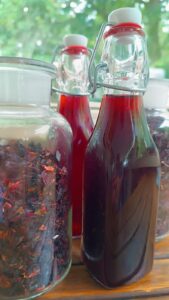
The beauty of hibiscus tea or karkadee is that you can fully adapt it to your own taste. For a stronger hibiscus flavor, use more dried hibiscus and/or let it steep longer.
You can add:
- Honey, agave syrup, stevia, or (cane) sugar to soften the acidity
- Lemon juice or a slice of lemon
- A slice of orange
- A cinnamon stick (or a pinch of ground cinnamon)
- A slice of ginger
- A sprig of mint – also lovely in combination with lemon
Especially the cold version pairs well with many ingredients, including fruit.
Personally, I prefer the cold drink, also because you can vary endlessly with it. And I love surprising people with this drink, which is still new to many.
That said, when it’s cold outside and I make a warm version with ginger and a bit of cinnamon, it’s a wonderfully comforting evening drink.
What is hibiscus tea good for?
Scientific research shows that hibiscus offers several health benefits, especially in relation to lowering blood pressure, reducing cholesterol, and supporting liver health. This is due to its high content of antioxidants, anthocyanins, and organic acids.
It is important to note that many of these findings come from studies using extracts, not tea. While tea can certainly have benefits, extracts often have stronger effects.
Nevertheless, research increasingly confirms the value of hibiscus for metabolic and cardiovascular health, and it has long been used in traditional medicine.
Scientifically supported benefits include:
- Lowers blood pressure – regular consumption has been shown to reduce blood pressure
- Improves cholesterol levels – may help lower LDL (“bad”) cholesterol, reducing cardiovascular risk
- Supports liver health – extracts may improve liver function and reduce fatty liver
- Antioxidant effects – rich in phenols and flavonoids, helping protect cells from free radical damage and inflammation
- Regulates blood sugar – may improve insulin resistance and help regulate blood glucose levels
- Supports kidney function – some evidence suggests it may help support kidney health
- Promotes digestion – supports hydration and healthy digestion and bowel function
On an energetic level, hibiscus tea invites you to slow down and be consciously present with what is alive within you. It supports the journey from the head to the heart, helping you feel more and relax more deeply.
What to be mindful of when drinking hibiscus tea
Although hibiscus tea is safe for most people, there are a few things to keep in mind:
If you take medication for high blood pressure, consult your doctor about whether you can drink hibiscus tea and how often
If you take other medications, it is always wise to check with your doctor as well.
Some people may experience side effects such as stomach discomfort or headaches; if this happens, stop drinking it and consult a healthcare professional.
If you are pregnant or breastfeeding, it is important to be cautious or avoid hibiscus tea altogether, as there is insufficient research on its safety during pregnancy and breastfeeding
Like many herbs, hibiscus has many beneficial properties, but it is not a miracle cure or a medicine. In my experience, too much of anything is rarely good.
So I would say: enjoy it, explore what you like best – and if you are nearby, I might just have a bag of hibiscus from Jordan for you, or some fresh syrup.

Hi, my name is Jolinda, and I work as a holistic health practitioner. I provide yoga and meditation classes and massage and Reiki treatments, mindfulness training and happiness coaching,.
With my blogs I hope to inspire you to make positive changes into your life. For more ideas and tips check out my page Jolindas inspiration. Free trainings and videos you can find at free downloads and videos
For questions and reservations, you can contact me per email